
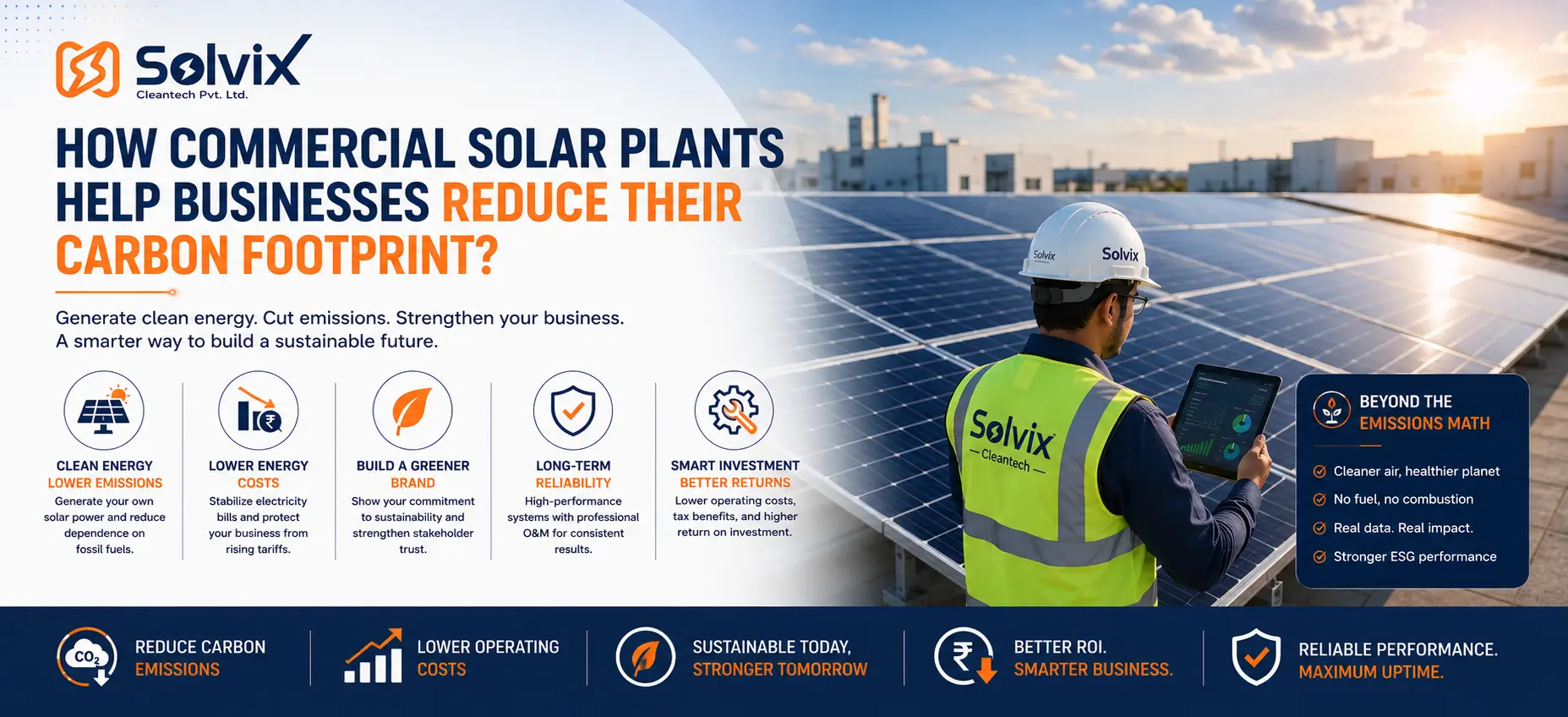
Ask a facility manager what’s changed lately and most say the same thing: someone above them now wants a straight answer on emissions. Not a mission statement — a number. That’s why commercial solar keeps coming up in board meetings that used to be purely about cost.
A commercial solar power plant answers that pressure with something you can point to: steel and glass on a roof, not a paragraph on a sustainability page. Here’s how it actually cuts a business’s carbon footprint, what one tends to cost, and how to plan a project properly in India.
What Is a Commercial Solar Power Plant, Really?
At its core, it’s a solar PV system sized for business use rather than a home — think factories, warehouses, hospitals, office parks. It shows up as rooftop solar, ground-mounted arrays where land allows, or open-access setups where the power comes from a plant built elsewhere entirely.
The difference between a plant that earns its keep and one that underperforms usually isn’t the brand of panel. It’s whether anyone did a proper load study before deciding how many panels would fit.
How Solar Actually Cuts Emissions?
The mechanism isn’t complicated. Coal still makes up a large share of India’s grid mix, so every unit of power a business generates on its own roof is a unit it isn’t pulling from that mix. Substitution, not magic.
How much it moves the needle depends on your specific numbers — consumption, system size, how carbon-heavy your regional grid happens to be. There’s no universal percentage that applies across businesses, and anyone quoting you probably hasn’t looked at your load data.
Something else happens once the panels go up: people start checking the generation dashboard, and then start noticing other things — a compressor running all night for no reason, a load pattern that doesn’t match the building’s actual hours. Solar rarely stays a standalone project for long. It tends to become the first step toward storage, efficiency upgrades, or open-access power for whatever load the rooftop system can’t cover.Something else happens once the panels go up: people start checking the generation dashboard, and then start noticing other things — a compressor running all night for no reason, a load pattern that doesn’t match the building’s actual hours. Solar rarely stays a standalone project for long. It tends to become the first step toward storage, efficiency upgrades, or open-access power for whatever load the rooftop system can’t cover.
Beyond the Emissions Math
A few other things worth weighing: sunlight doesn’t run out the way fossil reserves do, there’s no on-site combustion to worry about, and open-access or group solar models add clean capacity to the grid rather than just one building. Most useful of all — you get actual numbers to report, not a claim nobody can check. A specific figure holds up under questioning. A vague pledge doesn’t.
The Money Side Isn’t in Conflict With the Green Side
Let’s be honest — most projects get approved because the finance team signed off, not because sustainability won the argument alone. A properly built plant softens the blow of rising tariffs, makes energy costs predictable, and depending on structure, can bring tax benefits like accelerated depreciation.
None of that undercuts the environmental case. A project that makes financial sense gets built well and maintained on schedule, which is what delivers the emissions reduction in the first place. It’s roughly how businesses working with a partner like Solvix Cleantech tend to see it — the numbers and the outcome aren’t really separate conversations.
What Actually Moves Commercial Solar Power Plant Cost?
There’s no single price tag. Cost shifts with system size, the panels and inverters chosen, mounting structure, site conditions like shading and roof strength, and whatever electrical upgrades the grid connection needs. Installation quality matters more than people expect — a rushed job costs less upfront and over 25 years.
One thing gets skipped too often: monitoring and O&M. Not a one-time line item — it’s ongoing, and skipping it is usually the quiet reason a plant underperforms its design numbers for years without anyone noticing.
On Commercial Solar Power Plant Subsidy
Search this and you’ll find contradicting numbers everywhere, which tells you something on its own. India’s subsidy landscape for commercial solar is genuinely patchwork — central schemes, state policy, net-metering rules, accelerated depreciation for eligible businesses — and it shifts by location, business type, and project structure.
We’re deliberately not quoting a percentage here; anything specific written today could be outdated by the time you read it. Check directly with your state nodal agency or a solar partner actually tracking current policy.
Solar Power for Industrial Use
It doesn’t look the same everywhere. A manufacturing unit running two shifts through daylight hours is close to an ideal match for solar generation. A warehouse with acres of flat, unshaded roof is often sitting on wasted potential. Textile and processing plants running heavy equipment for long stretches can offset a real chunk of consumption if the system’s sized right.
What ties these together: an industrial solar power system only works as promised when it’s built around actual load data and kept running that way. Operations and maintenance support tends to be the difference between a plant hitting its numbers and one that quietly falls short.
10 Simple Ways to Reduce Your Carbon Footprint
- Size a solar power plant to actual usage, not roof space.
- Push flexible loads into daylight hours.
- Run an honest energy audit — most facilities find something.
- Swap outdated lighting and motors where it's worth it.
- Add real-time consumption monitoring.
- Keep HVAC and equipment properly serviced.
- Hunt down idle-time power draw and cut it.
- Improve insulation or shading to cut cooling load.
- Look at shared or open-access renewable options too.
- Track the data. Don't assume - measure.
Planning a Project Without Guessing
Most disappointing projects skipped a step somewhere. The order that works: load and site assessment first, system design sized to real usage next, then a realistic cost and feasibility check, then a look at subsidy and regulatory rules for your specific state.
Then comes the part that decides everything else. Installation and commissioning done properly — not rushed to hit a deadline — determines whether a plant performs from day one or spends its first year underperforming while someone tries to figure out why. Monitoring afterward is what keeps it there.
Where This Leaves You?
A commercial solar power plant gives a business a real way to cut its carbon footprint — not a promise, but electricity actually generated on-site. How much difference it makes depends on your numbers, not a figure someone hands you before they’ve seen your site.
If you’re figuring out whether a commercial or industrial system fits your operations, skip the generic quote and start with a proper assessment. Solvix Cleantech handles that full process — assessment through installation, and the years of running the plant that follow.
Frequently Asked Questions (FAQs)
By generating electricity on-site from sunlight instead of drawing it from a grid that’s still partly coal-fired, cutting the emissions tied directly to a business’s power use.
No — eligibility depends on business type, location, project size, and current policy. Confirm specifics with a state nodal agency or an experienced solar partner rather than relying on a fixed figure.
System size, equipment choices, mounting structure, site conditions, electrical infrastructure, installation quality, and ongoing O&M — all of it moves the number, which is why quotes vary so much.
Sometimes, depending on roof area, consumption, and how well the load lines up with solar generation hours. Many businesses offset a solid share of daytime usage without full coverage.
A poorly maintained plant quietly underperforms its design capacity, which directly cuts into how much grid electricity — and how many emissions — it was actually meant to offset.