
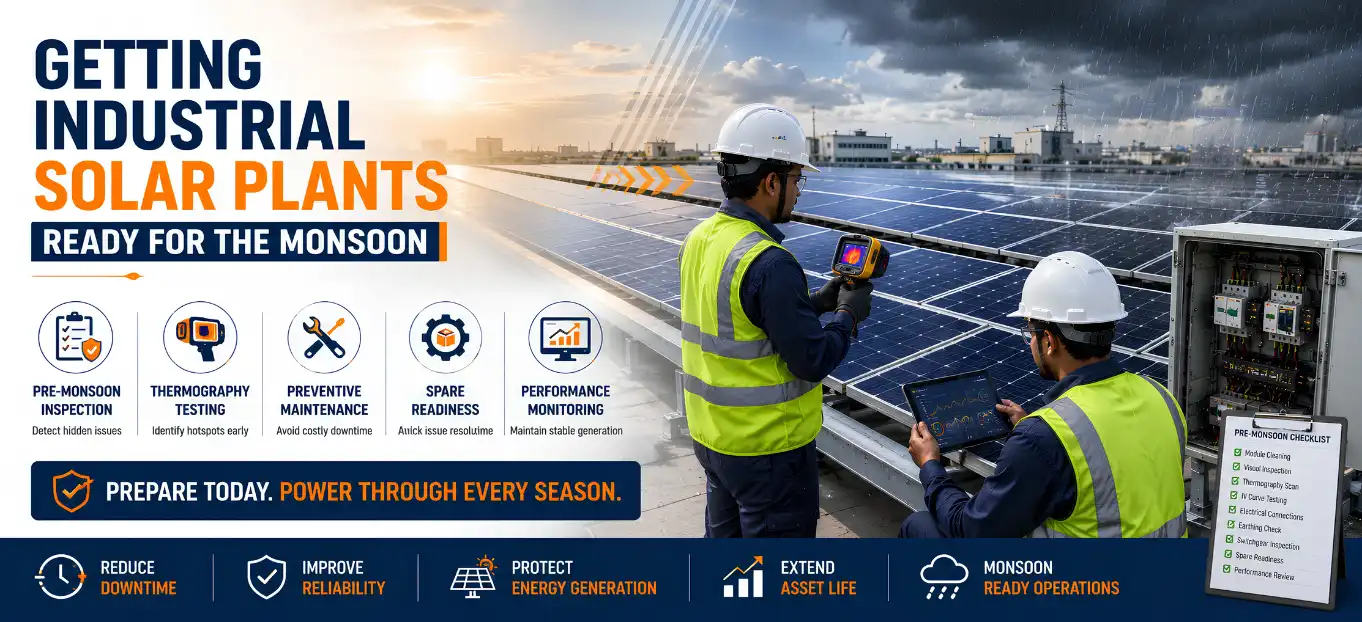
An industrial solar plant operates out in the open, dealing with the elements every single day. After enduring months of peak summer heat and heavy dust, a 100 kW or 200 kW Industrial Solar System might still show perfectly stable generation figures.
Because the numbers look fine, the plant rarely demands immediate attention. But as the monsoon approaches, most facilities naturally use the season change as a good time to look at the plant again. It is not about reacting to an emergency. It is simply a practical opportunity to take a closer look at the plant before the heavy rains begin.
What Usually Changes After Months of Heat and Dust?
These systems rarely develop major issues overnight. Most of the time, the changes are gradual. Dust accumulation is the most obvious factor, but other things shift, too.
A connection might loosen slightly after expanding and contracting in the summer heat. One string of panels might not be matching the exact output of the others anymore.
You usually do not see these things right away. It is often only when you review the generation numbers over a longer period that the small dips become visible. That is why many facilities choose to review the system before the weather changes.
Cleaning Helps. But It Is Only Part of the Story
When facility heads look at the roof before the monsoon, the first instinct is usually to schedule a wash. Removing months of grime is a necessary step, and proper solar cleaning services definitely make a visible difference.
However, washing the glass does not tell you what is happening underneath. The condition of the electrical system and mounting structures matters just as much as the surface of the modules.
Sometimes Generation Numbers Don't Tell the Whole Story
Operations teams rely heavily on remote monitoring and system performance reporting to track daily output. But those screens only show part of the picture. Generation numbers may look perfectly fine while a connection slowly wears out somewhere in the field.
That is where thermovision testing, I-V curve testing, and checks on DC, AC, transformer, and switchgear systems become useful. They help teams understand whether everything is behaving the way it should before the season changes.
For facilities coordinating solar inspection and testing in Vadodara, these technical reviews confirm that the high-voltage systems and 11/33/66 kV switchyard components are actually ready to handle the season.
Small Issues Are Easier to Deal With Before They Become Bigger Ones
Most maintenance teams would rather address a minor issue before the rains arrive than troubleshoot it once the monsoon is in full swing.
Most preventive maintenance work is not particularly exciting. Connections are checked. Minor issues are corrected. Documentation gets updated. Warranty matters are handled. None of it feels dramatic. But doing those things early usually prevents bigger disruptions later.
Waiting for Parts Is Sometimes More Frustrating Than the Fault
Equipment eventually fails. That is normal. What really disrupts a site is the time spent waiting for replacements.
Losing a week of normal generation while waiting for an inverter accessory or specific fuses is an avoidable loss. Having a reliable supply of Operations & Maintenance spares like MCBs, MCCBs, contactors, and relays sitting ready means the issue can be resolved in hours instead of days.
Looking Beyond This Monsoon
Preparing for the seasonal shift is just a practical step. The larger goal is always keeping the generation stable long after the current season passes.
For businesses managing ongoing solar rooftop maintenance in Gujarat, that means building a rhythm of regular reviews and steady care.
At Solvix Cleantech Pvt. Ltd. , we work with facilities across Vadodara to support long-term system performance through regular reviews, testing, and maintenance support.
If your team is preparing for the season and wants a clearer understanding of the condition of your solar plant, feel free tocontact us.